

Table of Contents
Introduction
Aerospace engineering is one of the most advanced, high-tech, and future-focused engineering fields in the world. Aerospace engineers are responsible for designing, building, testing, and maintaining aircraft, spacecraft, satellites, missiles, drones, and other aviation systems. Their work directly influences global travel, space exploration, defense systems, and modern communication technologies.
With rapid advancements in reusable rockets, commercial space travel, autonomous drones, and AI-powered aerospace systems, the role of aerospace engineers in 2025 has become more critical than ever. This guide explores what aerospace engineers do, their daily responsibilities, required skills, career path, job outlook, and more.
What Is Aerospace Engineering?
Aerospace engineering is a specialized branch of engineering focused on the design, development, testing, and production of aircraft and spacecraft. It is divided into two primary areas:
- Aeronautical Engineering – deals with aircraft that operate within Earth’s atmosphere (airplanes, helicopters, drones).
- Astronautical Engineering – deals with spacecraft and systems that operate outside Earth’s atmosphere (satellites, rockets, space vehicles).
Aerospace engineers apply advanced physics, mathematics, materials science, and computer technology to develop safe, efficient, and innovative flying systems.
Core Responsibilities of Aerospace Engineer
1. Design and Development
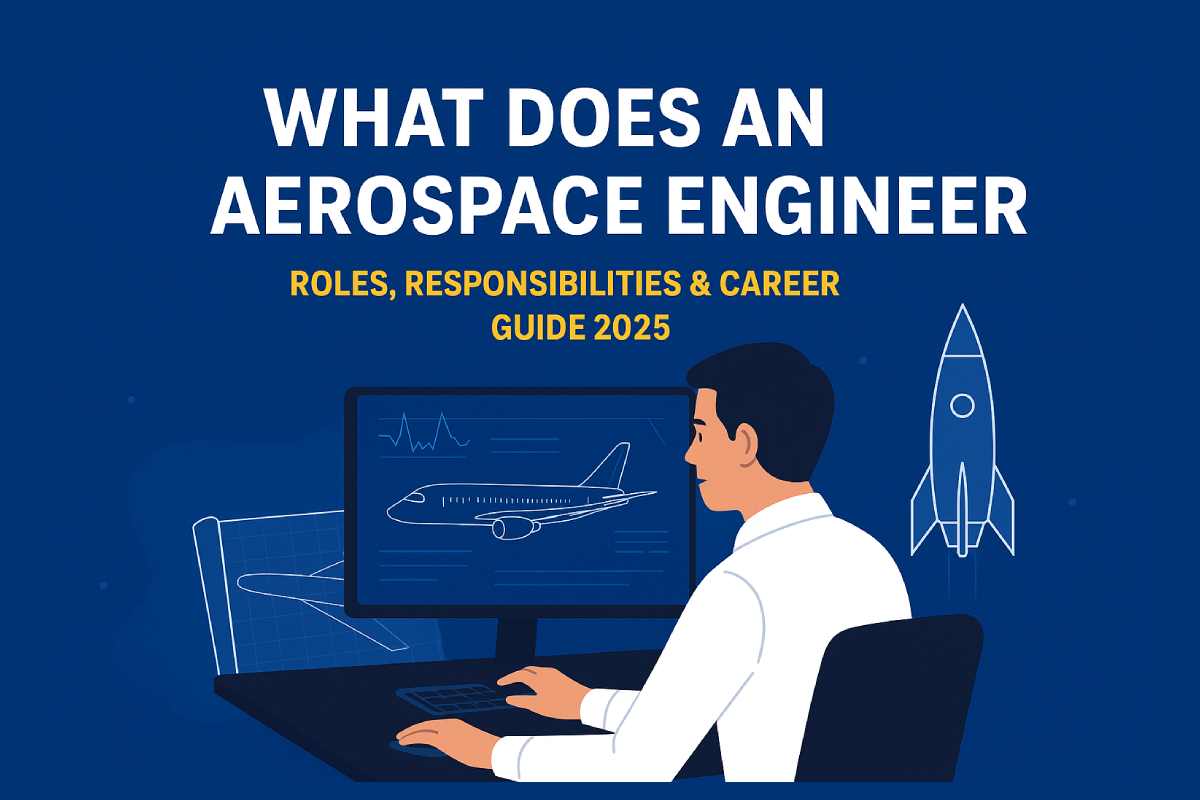
Aerospace engineers begin by designing components, systems, or entire aircraft and spacecraft. This includes:
- Creating blueprints and 3D models using CAD software
- Designing wings, engines, propulsion systems, control systems, and onboard computers
- Choosing suitable materials for strength, lightweight structure, and thermal stability
- Developing prototypes and design iterations
Their goal is to build systems that are safe, aerodynamic, fuel-efficient, and technologically advanced.
2. Testing and Evaluation
Testing is a crucial part of aerospace engineering to ensure safety and performance. Engineers conduct:
- Wind tunnel tests
- Stress and fatigue tests
- Flight simulations
- Engine and propulsion system tests
- Thermal and vibration analysis
In addition, aerospace engineers evaluate test data to identify potential failures or improvements before the system is deployed.
3. Performance Analysis & Simulation
Aerospace systems must perform flawlessly under extreme conditions such as high speed, pressure, temperature, and turbulence. Engineers use:
- Computational Fluid Dynamics (CFD)
- Finite Element Analysis (FEA)
- Simulation software for aerodynamics, propulsion, and structural behavior
These tools help predict how an aircraft or spacecraft will behave long before it is built or flown.
4. Collaboration & Compliance
Aerospace engineering is a highly collaborative field. Engineers work with:
- Mechanical engineers
- Electrical and electronics engineers
- Software developers
- Flight test teams
- Manufacturing and operations teams
They also ensure compliance with strict safety regulations and aviation standards set by authorities like NASA, ISRO, FAA, ESA, and Defense organizations.
5. Documentation & Reporting
Every design change, test result, calculation, and safety assessment must be documented. Aerospace engineers prepare:
- Technical reports
- Compliance documentation
- Design specification sheets
- Maintenance and operation manuals
Documentation ensures that systems are traceable, safe, and ready for certification.
Where Aerospace Engineers Work
Aerospace engineers can be found in a wide range of organizations, including:
1. Aerospace & Aviation Companies
- Boeing
- Airbus
- Lockheed Martin
- Northrop Grumman
- Rolls-Royce
2. Space Agencies
- NASA
- ISRO
- SpaceX
- Blue Origin
- ESA
3. Defense & Military Organizations
Engineering drones, missiles, tactical aircraft, surveillance systems, and defense technologies.
4. Research & Development Labs
Universities, government labs, and private research centers developing new materials, propulsion systems, and flight technologies.
5. Airlines & MRO (Maintenance, Repair, Overhaul)
Ensuring safe operation and maintenance of aircraft fleets.
Daily Tasks of Aerospace Engineers
A typical day for an aerospace engineer may include:
- Designing components or updating models in CAD software
- Running simulations to test aerodynamic performance
- Reviewing test results and modifying designs
- Participating in technical meetings or cross-team collaboration
- Supervising manufacturing or prototype assembly
- Writing reports, documentation, and project updates
- Solving operational problems related to aircraft or spacecraft
- Conducting research to improve efficiency, safety, and sustainability
Their work varies depending on the stage of a project—concept, development, testing, or flight operations.
Skills Required
Aerospace engineering demands a combination of technical and soft skills:
Technical Skills
- Aerodynamics & propulsion principles
- Structural analysis
- CAD & simulation software (CATIA, SolidWorks, MATLAB, ANSYS, CFD tools)
- Robotics and automation
- Avionics and control systems
- Material science
- Thermodynamics
Soft Skills
- Problem-solving
- Analytical thinking
- Team collaboration
- Communication skills
- Attention to detail
- Creativity and innovation
How to Become an Aerospace Engineer
1. Get the Right Education
Most aerospace engineers need at least a Bachelor’s degree in Aerospace Engineering or a related field like mechanical or electrical engineering.
2. Gain Practical Experience
Internships, research projects, and university labs provide valuable hands-on experience.
3. Develop Technical Skills
Learn CAD software, programming (Python, MATLAB), and simulation tools.
4. Pursue Advanced Degrees (Optional but Beneficial)
A Master’s or PhD can lead to research, teaching, or specialized roles in propulsion, flight dynamics, or space missions.
5. Certifications
Certifications from aviation authorities or engineering bodies improve career prospects.
Aerospace Engineer Salary & Job Outlook (2025)
The demand for aerospace engineers continues to grow due to:
- Commercial space exploration
- Military modernization
- Drone technology
- Sustainable aviation (electric and hydrogen-powered aircraft)
Average Salary in 2025
- United States: $95,000 – $140,000 per year
- India: ₹6 LPA – ₹18 LPA
- Europe: €55,000 – €90,000
- Middle East: AED 150,000 – 250,000 per year
Salaries vary based on experience, specialization, and employer.
Subfields Within Aerospace Engineering
Aerospace engineering includes multiple specializations:
- Aerodynamics
- Propulsion Engineering
- Aerospace Materials
- Flight Mechanics & Control
- Avionics Systems
- Spacecraft Design & Astrodynamics
- Unmanned Aerial Systems (Drones)
- Thermal Engineering
These subfields allow engineers to pursue careers in aircraft design, rocket engineering, satellite development, and more.
Frequently Asked Questions
1. Is aerospace engineering difficult?
- Yes, it is a challenging field that requires strong mathematical, scientific, and analytical skills.
2. Can aerospace engineers work in the software industry?
- Yes. Many aerospace engineers work in simulation, automation, AI modeling, and robotics.
3. Is aerospace engineering a good career in 2025?
- Absolutely. With rapid growth in space technology, drones, and sustainable aviation, aerospace careers are expanding globally.
4. Do aerospace engineers travel a lot?
- Some do—especially during flight tests or project inspections. Others work mainly in labs or offices.
5. What is the future of aerospace engineering?
- Reusable rockets, commercial space tourism, AI-driven aircraft, green aviation, and supersonic travel will shape the future.
Conclusion
Aerospace engineering is an exciting and innovative field that plays a crucial role in shaping the future of flight and space exploration. Whether designing aircraft, testing spacecraft, or developing new propulsion systems, aerospace engineers contribute to technologies that impact the entire world. For students and professionals entering this field in 2025, the opportunities are vast, challenging, and incredibly rewarding.
Also Read: How to Fix PS Remote Play Error 0x8801330f